My Flutes
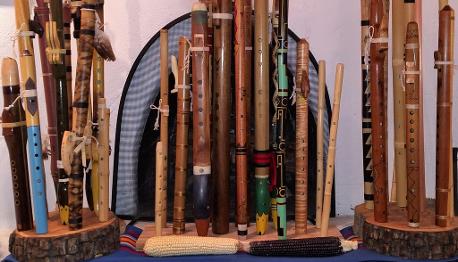
I currently make several types of flutes. They are unique and playable musical instruments with their own distinct look and voice.
Click here for my gallery of flute images.
- Pueblo-style Rimblown Flutes- These are an old style of flute made by ancient people of the American Southwest. This flute requires a little more dedication to learn the proper playing techniques.
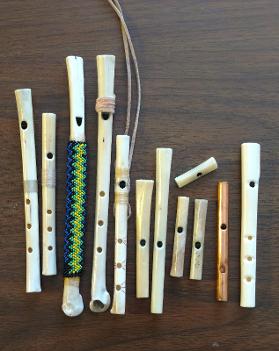
- Bone Flutes and Whistles- These are also an old style of flute made by ancient people of the American Southwest. These instruments are easy to play.
- O'odham Style Flutes- This style of flute comes from the People of Southern Arizona. These flutes require some technique to be able to play.
- Two-Chambered Block Flutes- This style is the most common type of flute found throughout the U.S. and are commonly called "Native American Flutes" They are easy to play.
- Single-Chambered Block Flutes- This type of flute is typically made from bamboo and made by indigenous people in Mexico. They are easy to play.
Educational Resources:
How I make my flutes
I use simple hand tools to make my flutes- knives, gouge chisels and hand planes. I also use some modern tools like belt sanders, routers, and rotary tools. I generally make these flutes with two pieces of wood from a split branch or store-bought pre-milled 2x1s. I remove center parts of each half with a gouge chisel or router, so that when glue the two halves together, they will form a tube. Some tubes I will drill out with a long drill bit so that there are no glue lines on the side of the flute. I hand-shape and sand each flute and sealed with various types of finishes, e.g. teak oil, danish oil, lacquer, polyurethane or spar urethane. I may also bind them in certain places to prevent splitting and also for decorative purposes (Waxed Nylon or Bead Cord).
- PVC and Bamboo- I also make more affordable well sounding flutes with PVC pipes and bamboo.
Buy a flute
My flutes are for sale here and on eBay in accordance to the Indian Arts and Crafts Act of 1990, because I am an enrolled tribal member of a Federally recognized tribe- Jemez Pueblo. I give flute performances, lectures and demonstrations about my flutes, and what I know about their history.
For more information about ordering, pricing and payment options, CLICK HERE.
DISCLAIMER:
Eagle bones are ILLEGAL to sell, trade or barter. Although, I may work on any Eagle bone that was LEGALLY obtained, just contact me for more information.
-
TESTIMONIALS
-
FOR SALE- Available flutes and ordering info
-
IMAGE GALLERY
-
My Uncle Jimmy- An Influence
-
My You Tube Videos
-
Music with Marlon
"PRAISE THE BONES!"
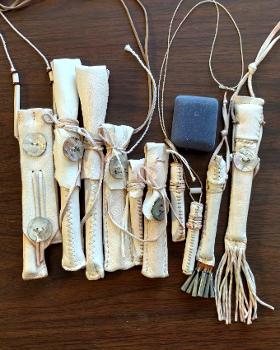
My collection of bone flutes and their cases.
My View of The Term, "Native American Flute"
Native American Flute refers to a specific type of flute or a flute made by a Native American, and because of the Indian Arts and Craft Act of 1990, this maker must be an Enrolled Tribal Member of a Federally Recognized Tribe. The term "Native American Flute" has been used by many makers to refer to some flutes and has become most popular. They are also known as, "Love Flutes", "Courting Flutes", and other terms. "Native American Flute" implies that all Native American tribes made or make the same type of flute, and that is not the case. There are hundreds of different tribes that made or make flutes, and each with their own names for the flute. Any Native American that makes flutes can call their flutes Native American Flutes. (I will refer to the more common type referred to as Native American or Native American Style flutes as "Two-Chambered Block Flutes", or simply "Block Flutes".) Although many tribes made flutes, Archaeologist have unearthed some of the oldest flutes from the American Southwest.
Pueblo Peoples of the Southwest have been using flutes ceremonially for hundreds of years, to conjure up rain spirits, clouds, and anything related to good crop growth. Most of these flutes were rim-blown, and some were bone flutes or whistles with a few holes. These flutes have been recently called "Anasazi" flutes, but I call them Pueblo-style rim-blown Flutes, or Pueblo Flutes. Not much is known by the public about how Pueblo Flutes were/are played by Pueblo Peoples due to the secretive nature of our lifestyle and beliefs; however, they are still used in modern Pueblos.
Historic Pueblo Flutes
My first example is a Zuni Pueblo Dance Flute (Image source: Objects of Myth and Memory: American Indian Art at the Brooklyn Museum). The decorations of this flute are quite simple yet beautiful: a decorated gourd attachment on one end with eagle plumes tied on the rim, and evergreen branches bound in the center where the dancer would have held this flute while dancing.
The second is a five-holed Hopi Flute from the Boston Museum of Fine Art.
The third is a four-holed flute from San Felipe Pueblo "collected" by a man named Spinden, in the early 1900s.
The forth is a four-hole flute from Cochiti Pueblo with fragments of a gourd attachment (American Museum of Natural History).
The fifth flute is a four-holed flute "collected " by Stuart Culin in 1907 whilst visiting Jemez Pueblo (Image source: Objects of Myth and Memory: American Indian Art at the Brooklyn Museum). It appears to be made out of a type of reed. It would have also had a gourd attachment on the bottom like the Zuni and Cochiti flutes. The gourd attachment represents a rain cloud with the eagle plumes representing rain. These Jemez and Zuni Flutes are now stored in the Brooklyn Museum of Fine Art.
There are also some historic Pueblo Flutes that are put up for auction, like this Kewa Pueblo Flute. It was on auction at COWAN'S, a consignment auctioneer. Pueblo People have historically used bone flutes as well. The image below is from an excavation of an old Jemez Village located in the Jemez Mountains, called "Unshagi", place of the Juniper trees. Other similar flutes have been found at other sites throughout the Southwest.
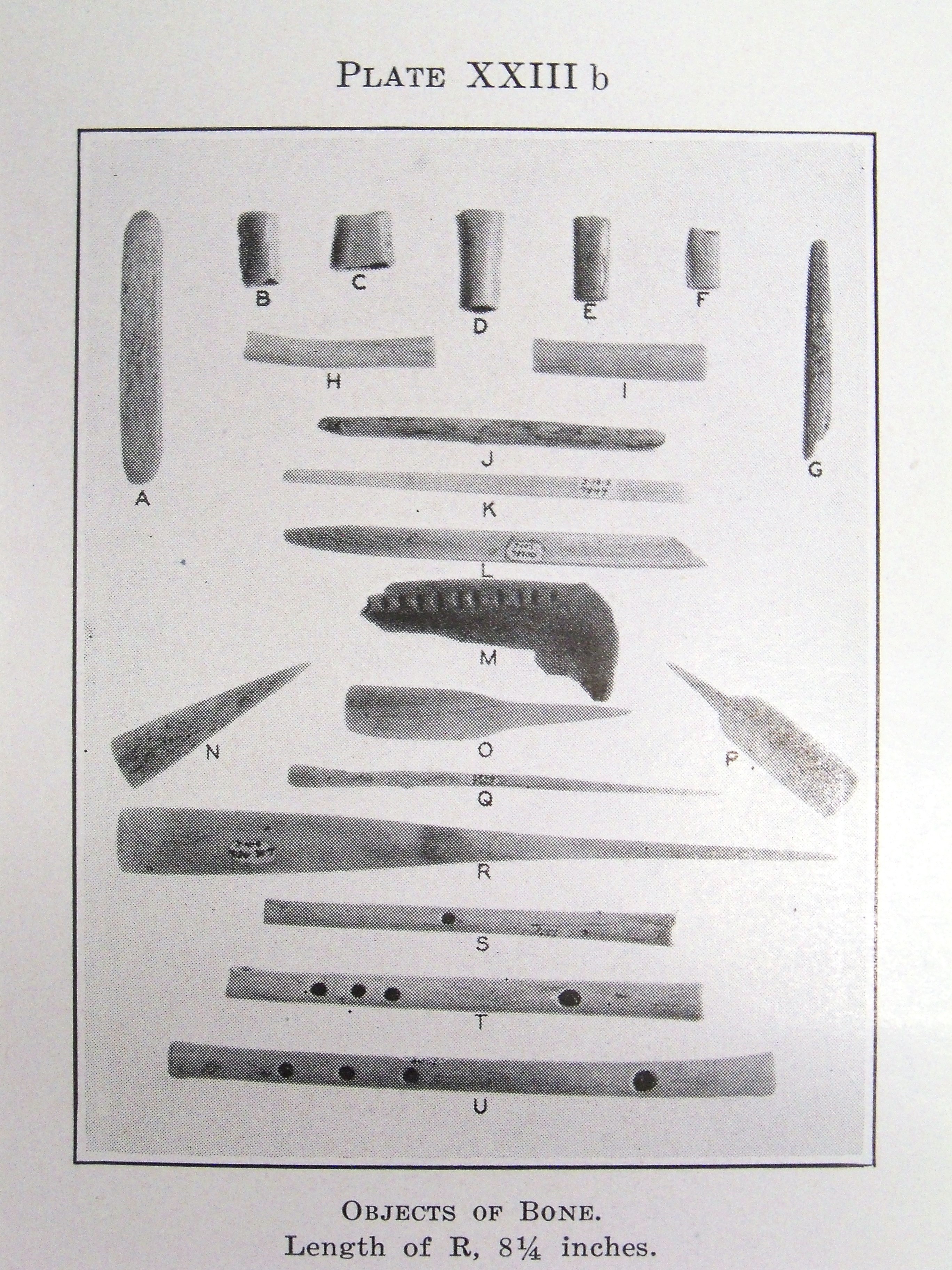
Bone artifacts from excavated Jemez ruin of "Unshagi". Image from The Jemez Pueblo of Unshagi, New Mexico, with Notes on the Earlier Excavations at "Amoxiumqua" and Giusewa by Paul Reiter, University of New Mexico Press, 1938.
Some more flute history can be found at Flutopedia